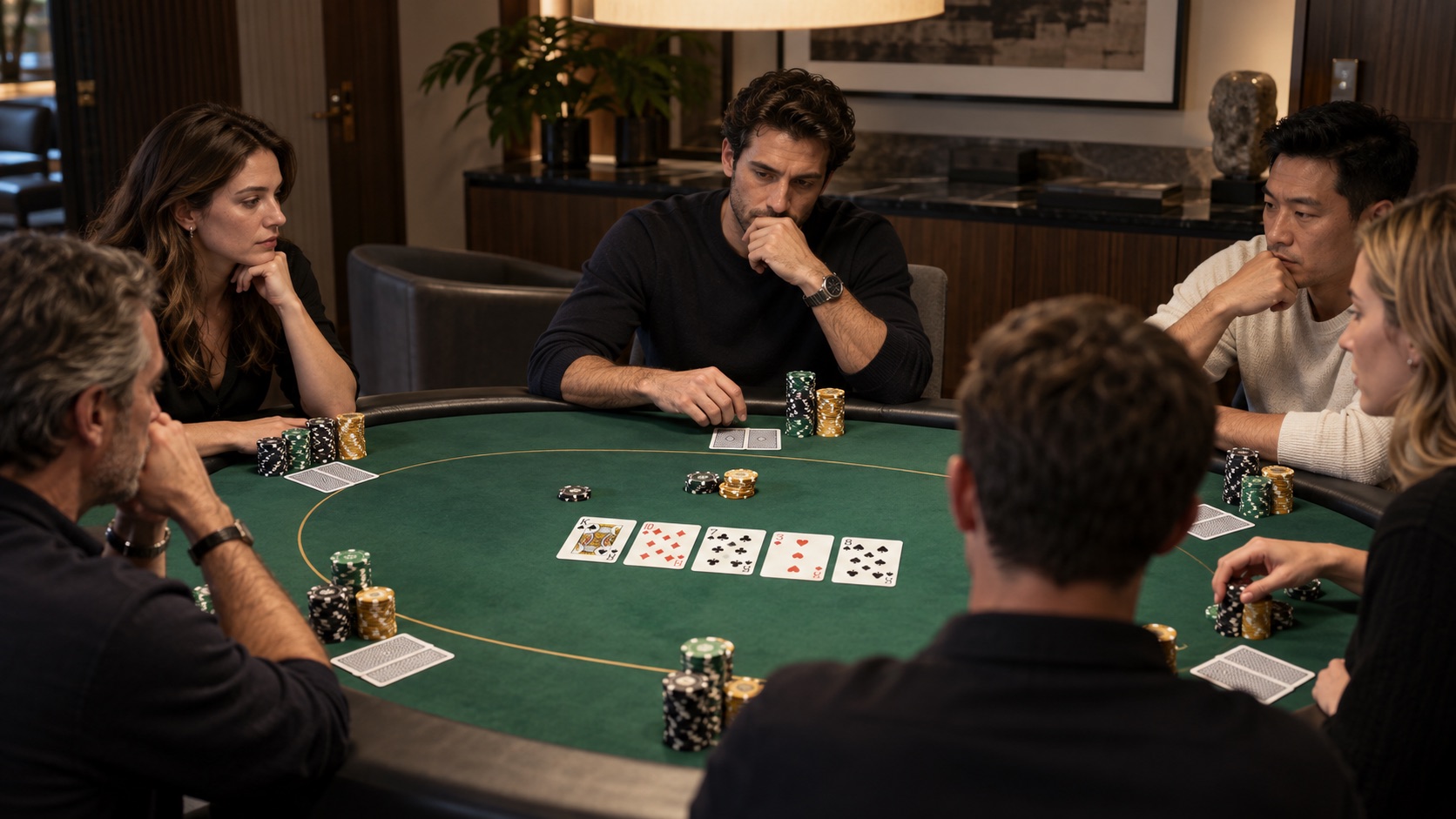
Imagine a table of cautious players. Hands keep folding. Someone occasionally raises, but meaningful confrontations are rare.
One player calls it discipline. Another asks, “I have been here for hours, mostly waiting. What am I supposed to enjoy?”
At another table, additional rewards and penalties encourage people to compete for more pots. The action becomes livelier. The variance and pressure to participate may rise with it.
These experiences raise a question: If poker draws most of its appeal from winning money and generating suspense, what remains when those rewards become scarce?
That question is part of why we think about poker's future, and why we believe ZenPoker is worth building.
We want more adults to understand poker and enjoy its competition, conversation, and learning. We especially want a completed hand to leave something beyond a financial result: a clearer understanding of the judgment that produced it.
Can making a better decision become something people look forward to?
1. Participation Needs More Than Bigger Pots
Folding may be the best-supported action available. Yet someone hoping to spend an enjoyable evening with friends can reasonably find repeated waiting unengaging.
Both experiences deserve respect. One player has no obligation to make a losing decision to entertain the table. Another should not be dismissed as ignorant for finding the experience dull.
The useful questions concern the experience people agreed to share and what the rules reward.
Some variants known as “Squid Game,” for example, use additional incentives to encourage players to win pots. Rules differ, and a changed payoff structure can change appropriate strategy. Such variants can also introduce more risk and social pressure. They cannot solve every standard game's participation problem.
Engagement can also come from clearer explanations, welcoming conversation, time-limited practice, play-money exercises, and discussing an interesting decision together.
A hand you never entered can still leave a question worth exploring. A fold can become a choice that others understand.
Waiting has a chance to become learning when players can see why it matters. A product has to make that value visible rather than simply asking people to be more patient.
2. Familiar Strategies Can Converge Without Ending Growth
Another common argument says that players eventually become similar in skill, leaving table selection as the only important edge.
Choosing an environment matters. Opponents, rules, fees, and your own condition all affect whether participation is worthwhile. Continuing at an expensive table of strong players with little identifiable advantage may be a poor choice.
That addresses the value of the environment. It does not establish that personal development has ended.
Remembering a standard action, understanding its assumptions, and rebuilding the decision under pressure are different abilities.
Two players may recognize the same familiar solution while responding very differently to deep stacks, multiway pots, unfamiliar sizes, or an opponent who has changed strategy.
Execution creates further differences. Who notices fatigue? Who admits an opponent read was wrong? Who preserves their range after losing a large pot? Who can accept a table change or an early finish without treating it as an injury to their identity?
Progress may become slower and its returns smaller. Familiarity with standard answers does not mean every part of decision-making has been developed.
We also prefer describing environments through evidence rather than reducing people to labels. A wealthy recreational player is not necessarily weak. A professional can still have leaks. People deserve respect; behavior and relevant samples deserve analysis.
3. Theory, Exploit, and Awareness Shape the Same Decision
ZenPoker aims to connect three capabilities:
| Capability | The question it helps answer |
|---|---|
| Rational strategy | What is justified by the current rules, ranges, and stack conditions? |
| Evidence-based exploit | What has this particular opponent shown that supports a departure from the baseline? |
| Self-awareness | Am I still judging honestly, or am I building a justification for an emotional reaction? |
GTO provides the framework. Exploit creates specific adjustments. Awareness keeps the decision honest.
Each needs the others. Calmness cannot supply missing pot-odds knowledge. Knowing theory does not establish that an opponent follows it. Catching one bluff does not mean you understand a person completely.
A player with weak foundations may most need range and mathematical work. Someone with strong theory but unstable execution may gain more from recognizing when resentment takes control. Useful training identifies the constraint that matters now.
Judgment also operates before and beyond a bet. Reading yourself, other people, and the table helps determine when to participate, adjust, wait, or leave. We call that capability momentum: responding to the situation with a sense of timing.
A complete decision-maker examines both the hand and their relationship with the game.
4. The Joy of a Better Decision Can Be Specific
Consider a practice scenario. You have just lost a large pot, and the same opponent bets into you on the next hand. You want to call because one thought keeps returning: “They cannot have it every time.”
This time, you pause. You reconsider position, ranges, sizing, and the evidence you actually have. You find insufficient support for continuing and fold. The opponent does not show. You receive no immediate confirmation that your fold was correct.
But you notice something: resentment appeared without automatically acquiring the right to place a bet.
That is a change you can record.
Another satisfaction comes from discovering that your original explanation fails and being willing to revise it. Another comes from understanding why a value bet is justified rather than asking only whether someone called this time.
Understanding, correction, and execution offer reasons to look forward to practice beyond hoping for a better run of cards.
Losses can still hurt. Nobody needs to force themselves to enjoy losing money. A more honest response is: I can regret the loss while appreciating a decision grounded in evidence and limits.
The reverse check matters too. Losing does not automatically qualify a hand as “a good decision with bad luck.” Process quality still requires facts, assumptions, and evidence.
5. AI Should Make Learning Easier to Do
The 2019 Pluribus research demonstrated a specialized AI outperforming elite professionals in six-player no-limit hold'em. It established an achievement in imperfect-information game research, not equivalent competence for general chat models. Read the original paper.
For a learner, we care about a different question: can AI make a decision easier to examine, understand, and test?
We want a useful AI review to support a process like this:
- Reconstruct the facts. Separate information available at the time from information revealed by the outcome.
- Examine the reasoning. Identify ranges, prices, alternatives, and the assumptions supporting the conclusion.
- Check opponent evidence. Distinguish one observation from a reliable tendency without inventing certainty.
- Notice the reaction. Examine whether fear, resentment, or the urge to prove something changed the question.
- Leave one practice task. Test one observable change in a comparable situation.
A tool built around this process should welcome “we do not know enough,” “that assumption is wrong,” and “I do not accept that recommendation.” It should acknowledge the limits of its model, data, and analytical conditions.
AI can help examine a choice. The choice and its consequences still belong to the person.
A product should be judged partly by whether users become better at asking questions and explaining decisions, rather than increasingly dependent on an answer that sounds certain.
6. Better Decisions Cannot Promise a Profit
Making poker more meaningful begins with honesty about its economics and risks.
Personal improvement is not the same as an advantage relative to opponents. Playing better than before may still be insufficient against stronger opposition, rake, time charges, and other costs. Even a positive expectation under a particular model cannot guarantee a profitable result over a finite period.
When players exchange chips among themselves and fees are deducted, their combined balance falls. More serious training cannot make everyone a lasting financial winner.
Decision training can work toward a better process. It cannot offer an earnings guarantee.
Real-money poker still carries gambling risk. Skill, awareness, and the language of spiritual practice do not remove that risk or establish poker as a suitable gambling substitute for everyone.
We want learning and challenge to be available through exercises without real-money stakes. Real-money participation must respect local laws and age requirements, exclude essential living funds and borrowed money, and preserve the freedom to stop. Chasing losses is incompatible with those boundaries. If stopping becomes difficult, pausing, leaving, and seeking real-world help take priority over further training.
Learning that continued participation is not right for you can itself be a valuable outcome.
7. What Can Travel From the Table Into Life?
Poker concentrates several difficult conditions: incomplete information, noisy outcomes, emotional reactions, and choices with consequences.
That makes it a setting in which to practice probabilistic thinking, evidence, and self-awareness. Improvement there does not automatically become improvement at work, in spending decisions, or in relationships.
The National Academies' How People Learn II discusses transfer in relation to training and application environments. Applying knowledge in a new setting requires opportunities to use it. Read the section on training transfer. This is not direct evidence that poker training broadly improves everyday life.
Transfer needs practice of its own. Review a workplace decision: what information was available? Which assumption went unchecked? Did a poor outcome expose weak reasoning or reflect uncertainty? What could you test differently next time?
Life also contains values that a poker model cannot represent. Cooperation need not require a loser. Other people should not all become targets for exploitation. Some choices cannot be measured in chips.
The habits we hope to carry forward concern evidence, risk, uncertainty, and our own reactions. Whether that happens has to be checked through specific behavior outside the game.
8. A Future With Room for More Kinds of Enjoyment
Competition, conversation, problem-solving, and learning can each have a place. Enjoying poker does not require everyone to adopt the same story about personal growth.
But if poker wants broader appeal, we believe one path deserves serious work: helping people experience challenge, feedback, and shared progress without continually increasing financial risk.
For ZenPoker, value should show up in concrete changes. Do users repeat a particular error less often? Do they admit missing information more readily? Do they honor limits chosen in advance? Can they explain their actions more clearly?
These goals require real use and observation over time. One AI score, a profitable evening, or more time spent in the product cannot establish them.
We hope more people will choose to learn poker, and that they will become better at choosing how it fits into their lives. Some will keep competing. Some will prefer play-money practice. Some will reduce their involvement. Others will leave with clarity.
Poker's future could include this satisfaction: the outcome remains uncertain, but I understand my choice better than I did before.
That is a direction we are willing to build toward.
In your next review, hide the result and write three sentences: what I knew at the time; what justified my choice; the one change I will test next. Then uncover the result and examine your explanation.
Start by recording and reviewing one hand. Give learning evidence, and keep participation a choice.