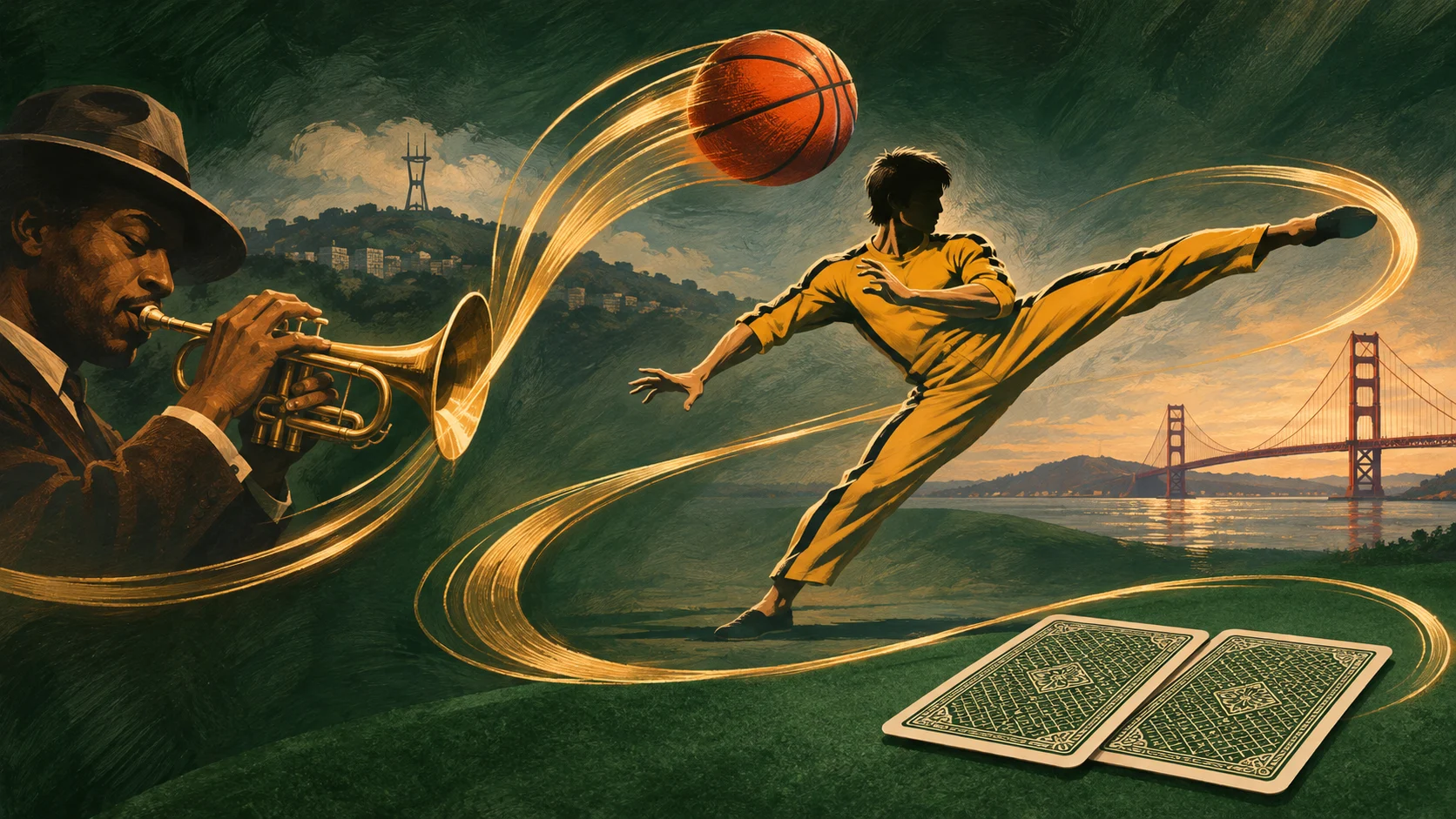
Beyond the Table · Part One
01 | From the Airport to the Hotel
On November 10, 2026, I arrived in San Francisco from China.
After the flight across the Pacific, I ordered an Uber to my hotel. It was the first day of this visit to the United States, and my first ride after landing.
The driver's name was John Halbleib.
As we talked, I learned that John was an experienced musician who also taught students; driving for Uber was a part-time job. He spoke about years of performing, trumpet and trombone, jazz and blues.
While preparing this article, I also found his public performance and recording credits. Cold Blood’s concert information lists him in the horn section, and Alligator Records’ credits for Stompin’ Ground name him on trumpet. His thoughts on practice and improvisation had a background in actual stage and recording work.
Music led us toward improvisation, Bruce Lee, and Zen practice. Later, I also spoke about ZenPoker, the AI poker project I am building.
We talked all the way to the hotel. One question kept returning: what is all this training ultimately for?
I had considered it while learning poker and building products. I had not expected to encounter it again, just after landing, through a musician's perspective.
02 | Becoming Fluent Enough to Listen
Talking about jazz, John used the expression “in the groove.”
“In the groove. That's kind of like in the zone, you know.”
I understood him to mean being inside the rhythm, close to what we often call flow: attention following the music as it happens, responding to what is there.
We went on to discuss practice and preparation. Why does action sometimes come naturally, while at other times the mind seems crowded with things it must work through?
Looking back on the conversation, I think one important difference is how many basic problems still need to be solved from scratch.
If every scale, rhythm, and fingering requires conscious checking, there is less attention available to hear what the other musicians are doing. My understanding of improvisation is that, as the foundations become familiar, a musician has more room to listen, assess, and respond.
That brought me back to learning poker.
Position, pot size, effective stacks, bet sizing, an opponent's range: when the basics are unfamiliar, each requires effort. Being physically at the table does not necessarily leave much attention available to observe it.
Practice has a concrete purpose here. Learn what can be learned in advance, so more attention remains for information that only appears in the moment.
Fluency in the basics can make room for a more attentive response to change.
I do not take flow to be a state that enough practice lets us activate on demand. Fatigue, pressure, and surroundings still matter. We can prepare well and also recognize that we may not be in good condition today.
03 | A Photograph, Basketball, and Bruce Lee
Talking about his collaborations, John mentioned basketball great Kareem Abdul-Jabbar and showed me a photograph of the two of them together.
Abdul-Jabbar was the basketball star who appeared alongside Bruce Lee in Game of Death. Criterion’s film information records their roles. Music, basketball, and kung fu had found a connection in this ride from the airport to the hotel.
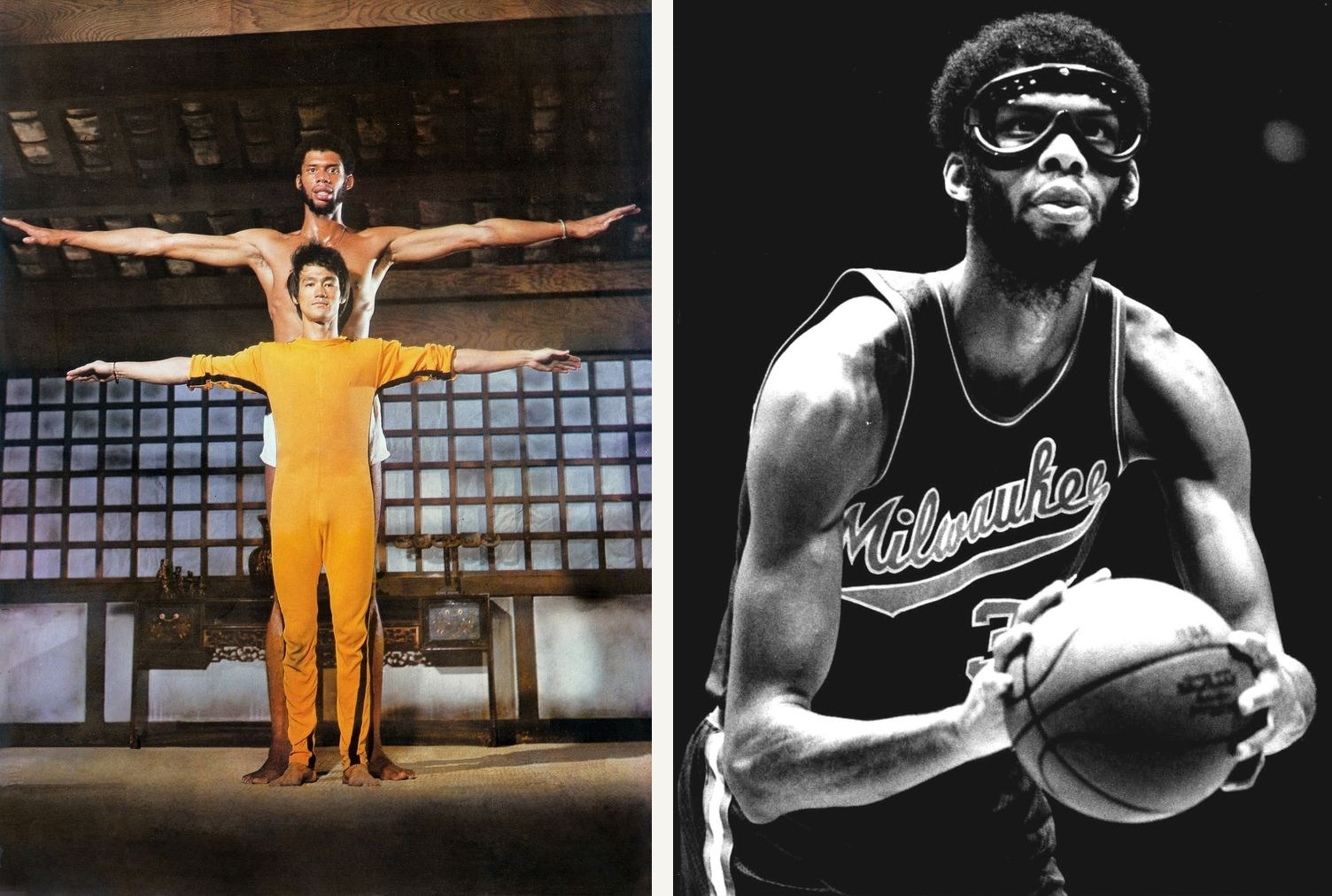
Left: Lee and Abdul-Jabbar on the Game of Death set, via ShotOnWhat?’s behind-the-scenes archive. Right: Abdul-Jabbar in his Milwaukee Bucks uniform in 1974, photographed by Frank Bryan, The Sporting News Archives, via Wikimedia Commons. The original historical photographs have only been proportionally resized and arranged side by side.
In one photograph, Abdul-Jabbar extends his arms behind Bruce Lee on a film set. In the other, he holds a basketball in his team uniform. The same person connects two seemingly distant worlds. It suggested another question to me: after preparing thoroughly, how do we respond to different people and conditions?
John had also tried martial arts. He did not describe himself as particularly accomplished, but valued the idea of expressing oneself authentically and freely. As he understood it, that expression required preparation and applied to music as well.
Listening, I thought of the Chinese expression about moving beyond fixed techniques. This was my association, rather than John's wording or a quotation from Bruce Lee.
It is easy to hear “beyond technique” as permission to do whatever comes to mind. But without practice or an understanding of why a movement works, spontaneity may simply repeat our most familiar habits. Those habits can contain mistakes as well as experience.
I find a more useful interpretation: learn a technique, understand it, correct it repeatedly, and gradually become able to make justified changes as conditions unfold.
Music, martial arts, and poker are different practices. What I took from the conversation was a question about learning: does practice make me more responsive to reality, or merely more fluent in repeating myself?
04 | Turning an Idea into an Ability
In poker, that question is difficult to avoid.
Knowing that position matters does not mean considering it whenever we enter a pot. Being able to explain pot odds does not mean using ranges and price when facing an uncomfortable bet.
Practice occupies the distance between understanding an idea and using it under pressure.
I want that practice to have a specific subject. For example, collect several old hands involving large river bets. Reconstruct effective stacks and actions, hide the results, and write down the value hands and possible bluffs I assigned to the opponent, along with the evidence.
Then examine the process. Am I looking for mistakes only in pots I lost? Once I see the showdown, do I forget that I did not know those cards earlier? Have I described “I do not want to lose again” as “he can never be bluffing here”?
Missing information should remain unknown. An unsupported assumption should be revised. Finally, choose one weakness and revisit it using old hands or practice without monetary wagering, checking whether the decision process actually changes.
Review separates a vague experience into parts. Practice connects the corrected understanding back to action.
That kind of fluency may reduce the burden of solving basic problems during play.
It does not make every first instinct trustworthy. An unfamiliar situation still calls for slower thought. An adjustment to an opponent needs observed behavior and sufficient evidence. Risk beyond a preset boundary calls for stopping participation.
The freedom I hope to develop includes adjusting to evidence and recognizing what I still do not know. Familiarity with theory should leave room to revise a judgment.
05 | Letting Go Enough to See the Facts
Beyond technique, I also thought about my interest in and practice of Zen over the years.
Sometimes what blocks judgment is a self that urgently needs to be defended: I cannot lose to this person. I cannot fold here. I must get it back today.
Those thoughts can arrive dressed in strategic language. Analysis continues, but the desired answer has already been chosen.
Awareness is useful to me when it helps me notice that shift sooner. A moment ago, I was assessing a range; now I am protecting my pride. A moment ago, I was following a plan; now I am arguing with an outcome.
Noticing may not immediately bring calm. But I can refrain from letting the emotion decide the next hand, and end participation when necessary.
Play the hand, Drop the self.
Here, “the self” refers to attachment, identity, and the ego demanding a particular result. Letting go still requires calculating risk, examining outcomes, and accepting the real consequences of each choice.
An insight does not erase a loss. Flow cannot justify extending a session. Poker involves financial risk and variance; knowing ourselves does not require more wagering. Being able to stop is part of the ability I want to develop.
06 | The Freedom I Hope Training Can Make Possible
At the hotel, our conversation came to an end.
My first day in the United States, my first Uber ride from the airport: I had needed transport to a hotel and left with a question worth continuing to explore.
A musician prepares for improvisation. A poker player prepares for decisions. I hope my own practice leaves me less driven by habit and more able to respond to reality.
Later, organizing my thoughts about the encounter, I wrote down two sentences:
Preparation leads to freedom.
Train deliberately. Play naturally.
These are my summaries of the encounter, rather than quotations from John or Bruce Lee. They do not imply that training guarantees flow, much less that it guarantees winning.
For me, freedom is a direction for training: being able to think when thought is needed, adjust when evidence supports it, and stop when it is time to stop.
That is also something I want to put into practice through ZenPoker.
AI can help organize facts, examine assumptions, and present recurring decision problems away from the table. A person then checks the analysis and turns a review into a small exercise they can verify. AI can misread information and make mistakes; its contribution needs scrutiny.
I hope using the tool gradually supports more independent judgment. At the table, a player should have their own preparation, attention, and boundaries.
In my next offline review, I want to choose one recurring difficulty, hide the result, state my reasoning, and test one action. I want to see how much of what I thought I understood has become an ability I can use.
As for this first day of the trip, I want to remember John and the conversation that carried us from the airport to the hotel.
A journey had just begun. A familiar subject—training—had acquired another meaning I wanted to put into practice.
The encounter took place on November 10, 2026, in the San Francisco Bay Area.
DoubleAaron · Beyond the Table, Part One